
UV vs Fiber Laser — Real Material Behavior Explained by Wavelength
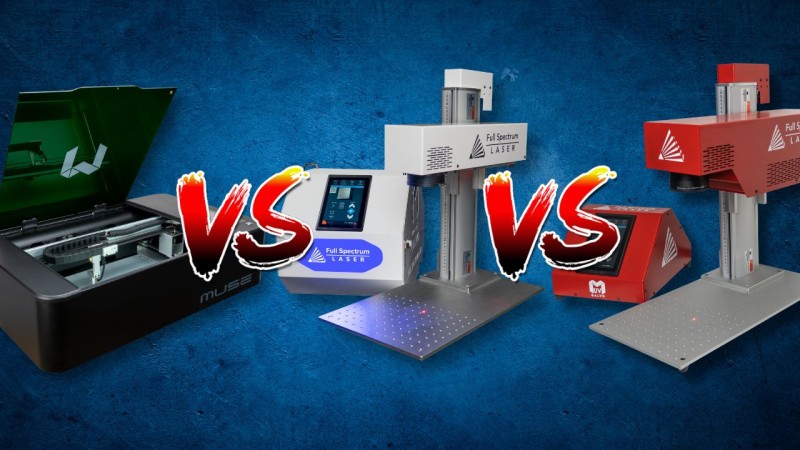
Choosing Between UV and Fiber Lasers: What Really Happens When Light Meets Different Materials
Every engraver eventually reaches this question: should you go with a UV laser or a fiber laser? On paper, they may look like they can do the same job — both can mark, engrave, and even cut in some cases. But once you start testing them side by side on different materials, their true personalities come to light. The way each laser interacts with a surface depends on something invisible yet decisive: wavelength. Understanding this single detail can save you money, frustration, and wasted materials down the road.
The Real Difference: Wavelength and Material Absorption
Both machines are lasers, but they speak different “languages” of light. A fiber laser operates around 1064 nanometers, producing infrared light. This longer wavelength is easily absorbed by metals, which is why fiber lasers are unbeatable for engraving stainless steel, brass, aluminum, copper, and titanium. The beam penetrates deep into the metal, heating it until it vaporizes or oxidizes, leaving a permanent, high-contrast mark.
On the other hand, the UV laser fires light at roughly 355 nanometers — three times shorter in wavelength. Ultraviolet energy doesn’t rely primarily on heat; it triggers a photochemical reaction on the material’s surface. That’s why UV lasers are often called “cold lasers.” They don’t burn or melt; they alter the molecular bonds directly. This unique behavior makes UV perfect for delicate or heat-sensitive materials like plastics, acrylics, glass, and coated surfaces. You get clean, precise marks with zero burn edges.
How Each Laser Behaves on Real Materials
Let’s break down how both lasers perform across common engraving surfaces. The behavior differences are not just about power — they’re about physics.
- Metals (steel, aluminum, brass, copper): The fiber laser wins without contest. Its energy couples perfectly with metallic surfaces, creating dark, rich, and deep engravings. A UV laser can only affect the top coating on anodized aluminum or painted metals but won’t mark bare metal effectively.
- Plastics and acrylics: This is where the UV laser shines. It engraves without melting or warping, producing bright, frosty lines. Fiber lasers, being infrared, overheat plastics quickly, causing burns and inconsistent results.
- Glass and ceramics: The UV laser etches cleanly and precisely, without cracking the surface. Fiber lasers usually fail here — the beam passes through glass or shatters it from uneven heating.
- Wood and leather: UV produces lighter engravings, fine and controlled. Fiber lasers burn deeper and darker, creating a stronger contrast but often losing fine detail on softer materials.
- Stone and rubber: Both can engrave, but with different personalities. The UV laser is cleaner and better for detail; the fiber laser creates deeper, rougher textures ideal for industrial or high-wear parts.
- Textiles, paper, and organic fibers: The UV beam creates precise marks without scorching. A fiber laser would instantly burn through.
Why the Same Design Looks Different on Each Laser
The way a design looks after engraving is not just about power or speed — it’s about how the laser’s wavelength interacts with color, density, and reflectivity. A metal logo that looks crisp and dark under a fiber beam might turn faint or nearly invisible with a UV laser. Meanwhile, a delicate logo on acrylic might appear flawless with UV but would melt into a mess with infrared.
This is why professional engravers often talk about “matching the beam to the job.” It’s not just choosing the right settings — it’s understanding how energy transfers into the surface. Fiber lasers heat, UV lasers react. The result is a completely different kind of mark, even if your file and focus are perfect.
Vector Design and Software Preparation
Even the most powerful laser won’t save a poor design file. Vector preparation is key to precision, regardless of the laser type. Clean, closed paths ensure smooth engraving passes, and grouped elements prevent the laser from jumping between isolated nodes. Using design tools like LightBurn, you can control power, speed, and frequency for each layer — and these settings behave differently between UV and fiber lasers.
- For fiber lasers, adjusting frequency (kHz) changes how dark or light the engraving appears. Higher frequency means smoother, lighter marks; lower frequency gives more aggressive ablation and deeper contrast.
- For UV lasers, the priority is pulse energy and speed. Too much overlap burns the surface, while too little creates faint or incomplete marks.
When designing for production, I recommend saving separate parameter presets in LightBurn for each material and laser type. That way, if you use both UV and fiber systems, you can switch projects quickly without recalibrating every time.
Precision vs. Power: Where Each Laser Excels
Think of the fiber laser as a powerful hammer and the UV laser as a scalpel. The fiber delivers brute strength for deep, permanent marks and cutting through reflective metals. The UV, however, thrives in finesse — small text, logos on plastic housings, QR codes on microchips, or serial numbers on glass. Its smaller spot size and cold reaction allow engravings as tiny as 0.01 mm without heat spread.
In production environments, companies often use both. The fiber handles all metal identification, tool marking, and serial engraving, while the UV laser manages plastic, silicone, and coating applications. This workflow ensures maximum efficiency across all materials while keeping results consistent in style and readability.
Unexpected Uses and Real Applications
One interesting application of UV lasers is in PCB prototyping and microelectronics. Because it can remove copper coatings precisely without damaging the board, it’s used for circuit marking and repair. The fiber laser, on the other hand, is commonly used to clean metal parts or even remove rust — a task UV cannot handle due to its lower thermal output.
When it comes to engraving stone, both lasers can deliver unique results. Fiber creates a deeper, grainier mark perfect for industrial labels or tools, while UV can add subtle, shallow engravings ideal for artistic surfaces like slate or marble coasters.
Choosing the Right Laser for Your Workshop
If most of your work involves metal — stainless steel cups, knives, tools, brass tags, or aluminum nameplates — then a fiber laser is the practical choice. It’s fast, durable, and can run for hours without losing power stability. If, instead, you work with plastics, glass, coated metals, or mixed materials, a UV laser will open creative doors that fiber simply can’t. It’s the go-to for detailed branding, delicate items, and any surface that needs a clean mark without heat distortion.
Of course, both require proper focusing and safety awareness. Fiber lasers reflect dangerously off shiny metals, while UV lasers require eye protection due to invisible ultraviolet radiation. Always use certified enclosures and goggles that match the correct wavelength rating.
Fine-Tuning Settings for Professional Results
Whether you use LightBurn or manufacturer software, it’s smart to think of settings as a triangle between power, speed, and frequency. Changing one affects the others:
- Lower power and higher speed = lighter surface mark.
- Higher power and slower speed = deeper, darker engraving.
- Frequency controls the density of pulses — too high may blur the detail; too low may leave gaps.
For UV engraving, a good baseline is fast movement with moderate power — you’re sculpting the surface chemically, not thermally. For fiber engraving, slower passes with high energy give better definition and durability. A simple tip: always test on scrap material before production. The surface finish and color response vary even within the same metal type, especially with anodized or coated parts.
Final Thoughts: Precision Is About Understanding Light
There’s no single winner between UV and fiber — only the right match for your workflow. Fiber is the muscle; UV is the artist’s brush. The real magic happens when you understand how wavelength, power, and material properties interact. Once you grasp that, every engraving becomes predictable, repeatable, and professional-looking.
And that’s what separates testing from mastery — knowing not just how to fire the laser, but why the result looks the way it does.
Visit Laser-Secrets.com for tested LightBurn libraries and laser engraving settings.
