
Fiber Laser vs MOPA Fiber vs UV vs CO₂ Laser — How to Choose the Perfect Laser Engraver for Your Needs
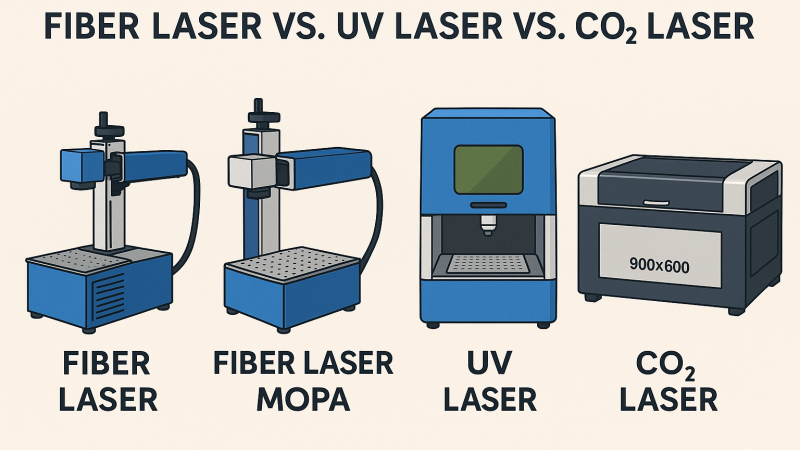
Fiber Laser vs MOPA Fiber vs UV vs CO₂ Laser — How to Choose the Perfect Laser Engraver for Your Needs
A practical, SEO-friendly guide covering how each laser works, what materials they excel at, costs, ROI, and a crucial chapter on settings and focus.
Fiber • MOPA Fiber • UV • CO₂ • LightBurn Settings
Choosing the right laser engraving machine can dramatically improve your workflow, precision, and productivity. With so many technologies available — Fiber lasers, MOPA Fiber lasers, UV lasers, and CO₂ lasers — understanding their differences is the key to achieving perfect results every time. In this complete guide, we explore how each laser works, what materials they’re best for, and which one fits your production goals.
1. How Each Laser Works
Fiber Laser (1064 nm — Infrared)
Fiber lasers use a fiber-optic gain medium that amplifies infrared light (~1064 nm). They engrave by heat (thermal ablation) — removing material through precise melting or vaporization. This makes them perfect for metals, such as stainless steel, titanium, aluminum, brass, and copper, as well as coated materials.
MOPA Fiber Laser (Adjustable Pulse Duration 2–500 ns)
MOPA (Master Oscillator Power Amplifier) is a more advanced version of a fiber laser. It allows you to control pulse duration and frequency, unlocking applications that standard fiber lasers can’t handle. You can mark color on stainless steel and titanium, engrave on plastics with less burning, and achieve softer contrasts on anodized aluminum. MOPA lasers are the most versatile fiber systems, perfect for both industrial and artistic use.
UV Laser (355 nm — Ultraviolet)
UV lasers operate at a wavelength of around 355 nm, producing cold markings through photochemical reactions. Instead of burning material, the UV beam breaks molecular bonds — making it ideal for plastics, glass, and other heat-sensitive materials. Result: extremely fine, clean engravings with no burns, discoloration, or deformation.
CO₂ Laser (10.6 µm — Infrared Gas Laser)
CO₂ lasers use a gas mixture (mainly carbon dioxide) to produce a long infrared wavelength of 10.6 µm, which is absorbed by organic materials. They are the go-to choice for wood, acrylic, leather, paper, fabric, and glass etching, but are not suitable for bare metals unless the surface is coated.
2. Material Compatibility Comparison
| Material | Fiber Laser | MOPA Fiber | UV Laser | CO₂ Laser |
|---|---|---|---|---|
| Metals (Steel, Aluminum, Brass) | ✅ Excellent | ✅✅ Excellent + Color | ⚙️ Limited | ❌ Not suitable |
| Plastics (ABS, PVC, PC) | ⚙️ Risk of burn | ✅ Excellent (no burn) | ✅ Excellent | ✅ Good |
| Glass / Ceramics | ⚙️ Limited | ⚙️ Limited | ✅ Excellent | ⚙️ Surface only |
| Wood / Leather / Paper | ❌ | ⚙️ Risk of damage | ⚙️ Not ideal | ✅ Excellent |
| Painted / Coated Surfaces | ✅ Excellent | ✅ Excellent | ✅ Excellent | ⚙️ Limited |
| PCB / Electronic Components | ⚙️ Limited | ✅ Excellent | ✅ Excellent | ❌ Not used |
3. Marking Quality and Speed
- Fiber Laser: Fastest engraving speed and high marking depth — perfect for serial numbers, barcodes, and permanent metal etching.
- MOPA Fiber Laser: Same speed but adds flexibility — color marking, high-contrast plastic engraving, and fine-tuned texture control.
- UV Laser: Slower, but unbeatable for precision and detail — ideal for micro text, logos, or medical components.
- CO₂ Laser: Great for cutting and marking non-metals; excellent for creative applications and organic materials.
For industrial speed, choose Fiber. For maximum versatility, choose MOPA Fiber. For delicate precision, go with UV. For crafts and non-metals, CO₂ remains the classic.
4. Efficiency, Maintenance, and Lifespan
| Laser Type | Efficiency | Lifespan | Maintenance |
|---|---|---|---|
| Fiber | High (≈40%) | 100,000 h | Very low |
| MOPA Fiber | High (≈40%) | 100,000 h | Very low |
| UV | Moderate (≈20%) | 30,000 h | Moderate |
| CO₂ | Lower (≈10–15%) | 8,000–10,000 h | Requires tube replacement |
Fiber and MOPA Fiber lasers are the most durable and cost-efficient long-term. CO₂ lasers need more frequent alignment and maintenance, while UV lasers trade lifespan for precision.
5. Cost and ROI
| Category | Fiber Laser | MOPA Fiber | UV Laser | CO₂ Laser |
|---|---|---|---|---|
| Purchase Price | ???? Medium | ???????? High | ???????? High | ???? Low |
| Operating Cost | ???? Very Low | ???? Very Low | ???? Low | ???? Moderate |
| Maintenance | ???? Minimal | ???? Minimal | ⚙️ Moderate | ???? Frequent |
| Profitability (ROI) | ⭐⭐⭐⭐ | ⭐⭐⭐⭐ | ⭐⭐⭐ | ⭐⭐ |
Fiber and MOPA Fiber lasers deliver the best return on investment for professional engraving and production environments. UV lasers shine in precision and specialty work, while CO₂ lasers are unbeatable for affordability and versatility.
6. How to Choose the Right Laser
- What materials do you work with most? Metals → Fiber/MOPA; Plastics/Glass → UV or MOPA; Wood/Leather/Acrylic → CO₂
- Do you need color engraving or high contrast? Yes → MOPA Fiber; No → Fiber or UV
- Is speed or precision more important? Speed → Fiber; Precision → UV; Flexibility → MOPA Fiber
7. Real-World Applications
- Fiber Laser: Automotive parts, steel tools, serial numbers, barcodes, firearms, industrial equipment.
- MOPA Fiber: Jewelry, stainless steel color marking, high-contrast plastics, branding and artistic engraving.
- UV Laser: Glass bottles, plastic casings, PCBs, electronics, medical devices.
- CO₂ Laser: Wood crafts, acrylic signage, leather goods, packaging, decor, trophies.
8. Summary Comparison Table
| Feature | Fiber Laser | MOPA Fiber | UV Laser | CO₂ Laser |
|---|---|---|---|---|
| Wavelength | 1064 nm | 1064 nm (adjustable pulse) | 355 nm | 10.6 µm |
| Heat Effect | High | Adjustable | Very Low | Moderate |
| Detail Level | ⭐⭐⭐ | ⭐⭐⭐⭐ | ⭐⭐⭐⭐ | ⭐⭐ |
| Speed | ⭐⭐⭐⭐ | ⭐⭐⭐⭐ | ⭐⭐ | ⭐⭐ |
| Color Marking | ❌ | ✅ | ❌ | ❌ |
| Best For | Metals | Multi-Material, Color | Plastics, Glass | Organic Materials |
| Lifespan | 100,000 h | 100,000 h | 30,000 h | 10,000 h |
9. Conclusion — One Technology Doesn’t Fit All
Each laser has its own strengths: Fiber Laser for deep, fast, industrial metal engraving; MOPA Fiber for versatility, color and contrast control; UV Laser for micro-marking, plastics, and heat-sensitive materials; and CO₂ Laser for wood, acrylic, leather, and creative cutting applications. If you work across multiple materials or industries, combining a MOPA Fiber and CO₂ laser can cover nearly every engraving scenario — from industrial to artistic.
10. Settings and Focus — The Hidden Secret Behind Every Perfect Engraving
No matter how powerful your laser is, your results will only be as good as your settings. Properly calibrated parameters — speed, power, frequency, fill type, pulse duration — can mean the difference between a dull, burned engraving and a perfectly crisp, professional result.
Good settings = predictable results. Random experiments waste time, materials, and energy — while optimized LightBurn libraries tested on real machines guarantee consistency, contrast, and depth.
Equally important is focus. A perfectly focused beam concentrates maximum energy at the correct distance, ensuring smooth lines and strong marks. Even a slight focus error can reduce power density by 20–40%, leading to blurry details, uneven colors, or poor surface definition.
- Use verified LightBurn libraries for your exact laser type and lens size.
- Recheck focus before engraving a new material or surface.
- Don’t rely on guesswork — use precision, not chance.
That’s how you turn your laser from a tool into a true production instrument.
Learn More
Visit laser-secrets.com to explore ready-made LightBurn libraries, tested settings, and professional engraving guides for Fiber, MOPA, UV, and CO₂ lasers. Save time, avoid guesswork, and get consistent, high-quality results — every time you engrave.
Explore Laser-Secrets